
Local SEO for Real Estate Agents: Rank in the Map Pack
Local SEO, Real Estate, Google Business Profile, NAP Consistency
Local SEO for Real Estate Agents: How to Actually Show Up in the Map Pack
Ranking in Google's local map pack as a real estate agent depends on three things working together: a Google Business Profile that is fully completed, verified, and actively used, business information that appears identically wherever you show up online, and a steady flow of genuine reviews and citations from real local sources. A website alone will not put you in the map pack, and neither will a claimed profile left half-finished. Local ranking is the outcome of consistent signals across the web telling Google you are a real, active, trusted agent in this specific place.
Here is how those signals work and the practical checklist to build them.
Why Local Ranking Matters More for Agents
A developer marketing one project sells until that project sells out. An agent's business is inherently local and recurring: the same city, the same neighborhoods, the same catchment of buyers and sellers coming into the market year after year. Local visibility is not a launch, it is the whole business.
The map pack, the block of three local business listings Google shows above the standard results for local searches, is often the entire first impression for that visibility. Someone typing "real estate agent near me" or "realtor in [neighborhood]" frequently picks from those three listings before opening a website at all. They see the name, the photo, the star rating, the review count, and the "call" or "directions" button, and they make a shortlist without ever visiting your site.
If you are not one of those three, you are effectively invisible for that search. The agents above you are not always better. They are agents whose local signals are built properly.
The Three Things That Actually Drive Local Ranking
1. Google Business Profile Completeness and Activity
Your Google Business Profile is the central document Google reads to decide what you are and whether to show you. Incomplete profiles get suppressed, abandoned ones fade even faster.
Complete means every field: correct categories with "Real Estate Agent" or "Real Estate Agency" as primary and secondary, service areas covering the neighborhoods you actually work, hours, a specific business description, correct name and phone, and photos that are yours, not stock. Add fresh photos regularly, of listings, signage, or events, because Google's system rewards activity.
Active means posting. Profile posts about new listings, market notes, open houses, or client wins are one of the least used and most rewarded signals. Agents who post weekly outrank agents who claimed their profile once and forgot it.
2. NAP Consistency Across the Web
NAP stands for Name, Address, and Phone number, and consistency here is more powerful than it looks. Google confirms who you are by cross-referencing your details across dozens of places: your website, your Google profile, real estate directories, brokerage rosters, LinkedIn, Facebook, and industry associations. When those details match exactly, confidence rises. When they conflict, confidence drops and the map pack quietly picks a competitor whose signals are cleaner.
Conflicts are usually small and unnoticed. An old office address on one directory, a personal mobile on your website and an office line on your profile, a middle initial in some places and not others, a doing-business-as name that differs from your legal listing. Each of these is a small vote for uncertainty. Fix them and ranking often moves without any other change.
3. Reviews and Local Signals
Reviews are the most public trust signal an agent has, and they carry real ranking weight beyond their conversion effect. Google looks at quantity, recency, and quality: steady genuine reviews across the past year beat a burst two years ago followed by silence, and both beat none.
Responding matters as much as receiving. A short professional response to every review, positive and negative, is another activity signal Google reads.
Alongside reviews sit local citations: your listing on real estate directories, local business directories, industry association sites, and any credible local publication that mentions you. Each citation is another consistent signal reinforcing the entity. They are slow to build and durable once built.
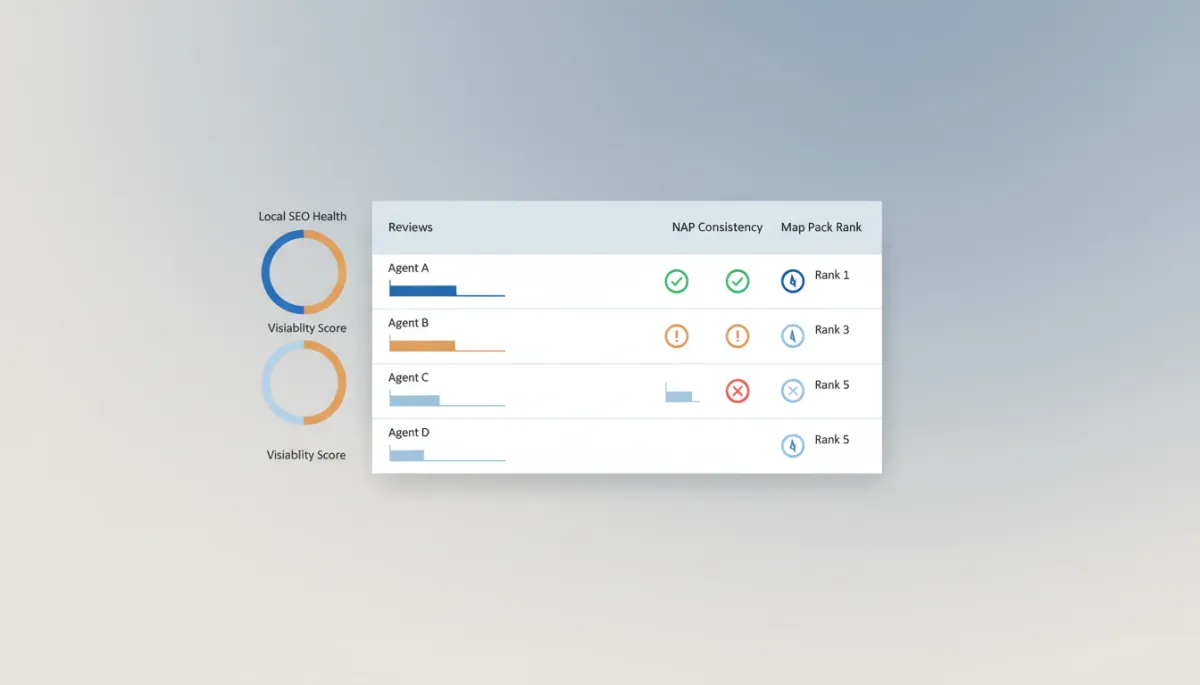
Small gains in reviews and NAP consistency often translate into outsized jumps in local rank.
The Practical Checklist for This Week
Real progress in local SEO is not glamorous, but it is specific. This is the list an agent can start today.
Claim and fully complete your Google Business Profile. Every field, correct categories, accurate service areas, real description, current hours, and at least ten to fifteen photos that are yours.
Audit your NAP across at least five places you appear online: website, Google profile, brokerage roster, LinkedIn, Facebook, and any directory you can find yourself on. Write the exact target version down once and make everything match it letter for letter.
Set up a simple review request process. After every closing, send one short message with a direct link to your Google review form, no gating, no filtering. Two or three reviews a month sustained beats a one-time push.
Post to your Google profile weekly: new listings, market notes, open houses, closed transactions with permission, or a short local insight. Consistency counts more than length.
Add real estate directory listings where you are not yet present, checking each one for the exact NAP details as you go.
Do this steadily for a few months and the map pack usually rearranges. Do it once and stop, and it does not.
Common Mistakes That Quietly Suppress Ranking
Four patterns account for most local invisibility. Multiple conflicting listings for the same agent, sometimes created accidentally after a brokerage change, sometimes lingering from an old address, each dividing your signal against yourself. An incomplete or abandoned profile, claimed years ago and never updated, which Google now treats as low signal. Review gating or paid or fake reviews, all of which can trigger review filtering or a profile penalty and are visibly detectable to Google's systems, so the shortcut is worse than doing nothing. And NAP inconsistency across directories, the quietest killer of all, because it never announces itself, it just holds you at position four.
None of these is exotic. All of them are fixable.
How Sayt Digital Handles Local Visibility
Local SEO is part of the broader visibility system we build for real estate clients, sitting alongside the wider organic strategy, directory presence, and the entity consistency work that also drives citation in AI-generated answers. The same fixes that lift a real estate agent into the map pack, clean NAP, active profile, review flow, and citation coverage, also strengthen everything else the brand does online. Done as one project instead of three, the results compound.
If you want to know why competitors are showing up in the map pack and you are not, the diagnosis is usually visible in an hour of audit. Book a consultation with Sayt Digital and we will walk through your current local footprint and show you what to fix first.
Frequently Asked Questions
How long does it take to rank in the local map pack?
Expect early movement within a few weeks of cleaning up your Google Business Profile and fixing NAP inconsistencies, with more substantial gains over three to six months as reviews accumulate and citations settle. Local ranking is a compounding signal, not a switch. Agents who post weekly and request reviews consistently see meaningful movement inside a quarter.
Do I need a website if I already rank on Google Business Profile?
Yes. The map pack drives calls and messages directly, but Google cross-references your website to confirm what your business is, and buyers frequently click through to a site before contacting you. A simple, fast, mobile-friendly site with matching NAP details reinforces every other local signal you have.
How many reviews do I need to rank well?
There is no fixed number, because it is relative to your local competitors. Look at the three agents ranking in the map pack for the searches you want and target more genuine reviews than the average of the three, with regular recency. Steady flow matters more than raw total, so build a request process rather than a review push.
Can I run local SEO myself or do I need help?
The Google Business Profile and NAP work is genuinely doable in-house, and doing it yourself is often faster than briefing someone else. Where help usually pays off is with directory and citation coverage, review process design, and diagnosing why current rankings are stuck, which is easier when you have seen many local profiles rather than only your own.
Does paying Google or buying reviews speed this up?
No. Google Business Profile itself is free, and paid or fake reviews are one of the fastest ways to get a profile filtered or penalized, since the detection systems are increasingly good. The only durable route is real completeness, real reviews, and real consistency, and it works.