Real Estate Marketing Budget Guide for Developers
Real Estate, Marketing Budget
Real Estate Marketing Budget: How Much Should Developers and Brokers Actually Spend?
A practical, numbers-first way to think about real estate marketing budgets, so developers and brokers can defend every dollar they spend.
There is no single correct real estate marketing budget, and anyone offering one is guessing. The right approach is to think in terms of marketing as a percentage of project value or expected revenue, and in cost per unit sold, adjusted for competition, timeline, and buyer profile, rather than picking an arbitrary flat figure. A budget that makes sense for a solo broker is meaningless for a two-hundred-unit development, and vice versa. The useful question is not "how much should I spend," it is "what does one unit sold need to cost in marketing, and how many units do I need to move by when."
Here is how to arrive at the number that fits your project.
Why Flat Numbers Mislead
Every developer and broker has heard a specific figure quoted: spend this per month, budget that per project, allocate this percent of revenue. These get repeated because they are easy to remember, not because they are right for any specific situation.
A budget that works for a boutique brokerage selling ten homes a year is meaningless for a large multi-phase development targeting hundreds of pre-sales in eighteen months. A number that fits a low-competition secondary market fails in a saturated one where competitors bid for the same audience. Copying a competitor's spend without knowing their unit count, price point, timeline, or conversion rate produces confident bad decisions.
The budgets that hold up are built from the project's specifics: value at stake, units to sell, timeline, and what a qualified buyer actually costs to acquire in that market.
A Better Framework: Percentage and Cost Per Unit Sold
Two views make the number defensible.
The percentage view frames spend against project value or expected revenue. The appropriate percentage varies widely by market, competition, project type, and urgency, so there is no honest single "industry standard" figure. What matters is that the number is set as a share of what the project needs to achieve, not a flat sum picked in isolation.
The cost per unit sold view sharpens this. Take the budget you are considering, divide it by the units it needs to sell in the target timeline, and compare that cost against what one unit contributes in margin. If sustained marketing costs a defensible amount per unit against your margin, the budget is working. If not, either the budget is wrong or the funnel underneath it is.
Work a simple illustrative example with your own figures. If the project needs to sell fifty units in twelve months, and a defensible cost per unit sold in your market is X, the annual budget floor is fifty times X. Adjust upward for competitive pressure and compressed timelines, downward if a strong warm interest list already carries part of the demand. What matters is doing the math with your numbers, not someone else's.
What Drives the Number Up or Down
Four variables move the answer significantly.
Local market competition. When multiple projects target the same buyer pool with active campaigns, you are bidding against everyone else. Paid media costs and the volume needed to break through both go up.
Unit count and timeline. Selling fifty units in twelve months costs more per month than the same fifty over three years, because urgency demands sustained pressure. Compressed timelines are the biggest budget multiplier developers underestimate.
Buyer profile. Local-only campaigns cost less than campaigns also targeting international or diaspora audiences, which require multi-city presence, longer nurture cycles, and often translated assets. The upside is that these buyers often carry higher ticket sizes and cash strength, but the budget needs to reflect the longer runway to close them.
Timing of the marketing itself. Pre-construction marketing that starts twelve to twenty-four months before launch costs less per unit sold, because the interest list built early does much of the work. Marketing that begins after the project is built and unsold costs significantly more.
Where the Budget Should Actually Go
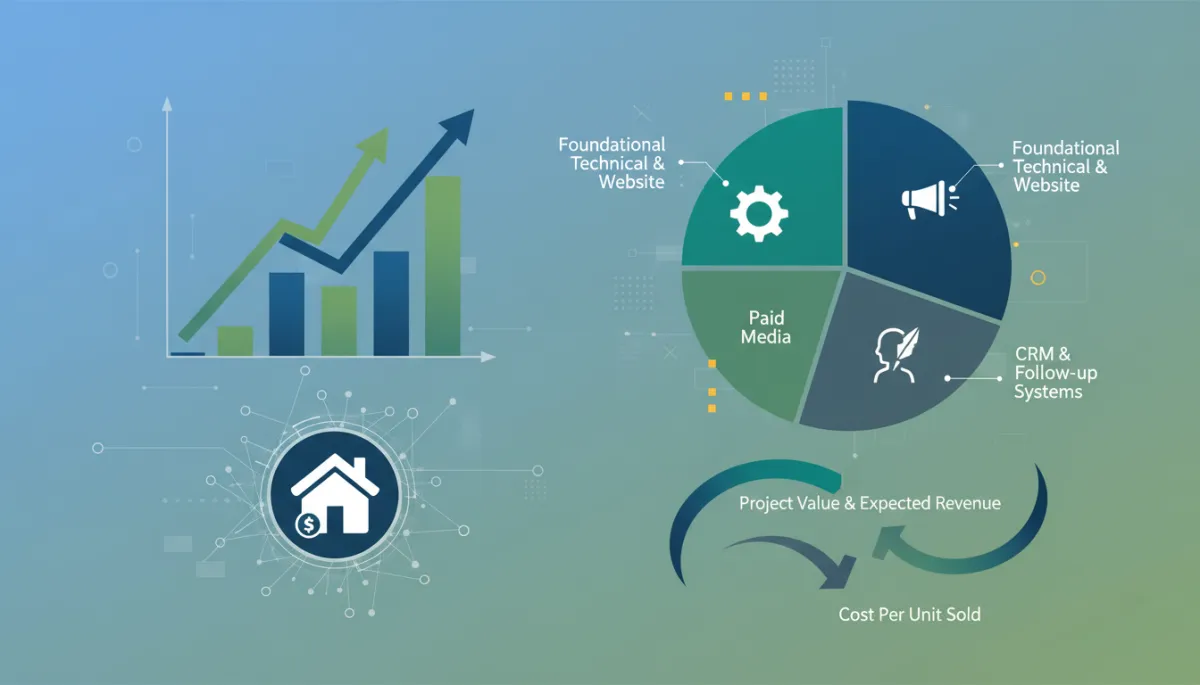
A defensible allocation across the four pillars looks roughly like this in practice.
Foundational technical and website work is a one-time or low ongoing cost. Site build, project microsite, tracking, and CRM setup are front-loaded then maintained. Underinvesting here is the fastest way to waste everything else, because the campaigns downstream convert through this foundation.
Paid media is usually the largest flexible line, scaling with urgency and timeline, and the line most projects overweight relative to what the site and follow-up can actually convert.
Content and SEO is a smaller ongoing investment that compounds over time. It rarely produces immediate revenue in the same quarter, and consistently produces long-run value through reduced dependence on paid traffic and stronger authority.
CRM and follow-up systems protect the return on everything else. Leads that go cold waste the budget that produced them, so spend on instant response, structured sequences, and pipeline visibility is essentially insurance on the ad line above.
Ratios shift by project, but all four lines have to exist. A budget missing any of them underperforms, no matter how large the total.

Tracking cost per lead and per unit sold turns vague budgets into measurable systems.
Common Budgeting Mistakes
Three patterns account for most wasted real estate marketing spend.
Spending the entire budget on paid ads with nothing left for the site or the follow-up system to convert traffic. This is the most common mistake, and it produces the classic "we spent a fortune on ads and got nothing" outcome. The ads worked. The funnel below them did not exist.
Treating marketing as a one-time launch expense instead of ongoing through the project. Launch surge is a starting point, not a finish. Absorption slows the moment marketing stops, and the units left in month twelve are always harder than the ones sold in month two.
Cutting budget the moment inquiries slow down instead of diagnosing the cause. Slower inquiries can mean the budget is too low, targeting drifted, a competitor launched, or the site stopped converting. Cutting first turns a small problem into a stalled project.
How Sayt Digital Approaches Budget Planning
We plan real estate marketing budgets for developers and brokers as part of the full buyer acquisition system, not in isolation from what the money is meant to do. That means starting from the sales target and timeline, working back to a defensible cost per unit sold, and allocating across foundation, paid media, content, and CRM so all four actually work together.
If you are trying to set a marketing budget for a project or your business and want a second look before committing, book a consultation with Sayt Digital and we will walk through the specifics honestly.
Frequently Asked Questions
What percentage of project value should go to marketing?
There is no single honest number, because it depends on market competition, timeline, project type, and buyer profile. The useful framing is to set the percentage against what the project needs to achieve, then defend it against the cost per unit sold it implies. Anyone quoting a universal percentage without asking about the project is guessing.
Should I spend more upfront or spread the budget evenly?
For most projects, front-load spend on foundation (site, tracking, CRM), sustain paid media across the sales period, and keep content and SEO running steadily rather than in bursts. Even distribution is rarely the answer. Absorption tapers over time, and so should the spend, but no phase should be zero.
What is a reasonable cost per qualified lead in real estate?
It varies by market, price point, and buyer type, so the number is only useful compared against your margin per closed deal. The question to ask is whether your current cost per qualified lead lets a reasonable close rate produce a profitable acquisition cost per unit sold. If yes, scale it. If not, fix the funnel before adding budget.
How do I know if my marketing budget is actually working?
By reporting on cost per qualified lead and cost per unit sold, not impressions and clicks. If those two numbers exist and are sustainable against margin, the budget is working. If the reporting cannot produce those numbers, the campaign's actual performance is unknown, which almost always means it is worse than assumed.
Can I start small and scale up?
Yes, but small has to still cover all four lines: foundation, paid media, content, and CRM. A tiny budget funding only ads underperforms every time. A modest budget funding a minimum viable version of all four produces learning fast, then scales into what works.